During the mid-nineteenth century, the world was in an uproar. Many countries in Europe were struggling with revolutions. In Prussia, the idea of combining the German states into a unified, single Germany was part of the revolutionaries' plans. But because of the failed reforms, many of these revolutionaries—most of whom were highly educated, politically astute and militarily trained—fled to the United States in search of a new life. Called “Forty-Eighters” because of their involvement in the revolutions of 1848, many of these Europeans arrived in America and became not only prominent citizens, but also contributors to and investors in their new homeland.
German immigrants also enlisted, some voluntarily and others not so voluntarily, in the United States Army. With the threat of secession by the southern states and what looked like a civil war brewing, many of these Germans sided with their newfound country in the effort to maintain the Union and, for some, to fight against the South's support of slavery. As the number of German immigrants rose, German officers were appointed to encourage these immigrants to enlist. This is a brief look at one such German who, by circumstance or fate, fell into obscurity behind his famous general brother and has been lost to the passage of time.
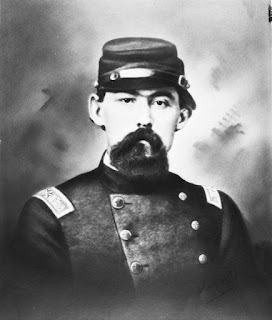
Colonel Albert Sigel was born in Sinsheim, Rhein-Neckar-Kreis, Baden-Württemberg, Germany, on November 13, 1827. He was the third child of Franz Moritz Sigel (1788–1864) and Anna Marie Pauline Lichtenauer, both of Germany. His siblings were the famed Civil War General Franz Peter Sigel (1824–1902), Laura, Theresa, Emil and Karl Sigel. Colonel Sigel immigrated to the United States in 1851 along with many other Europeans, including his brother Franz, who were called Forty-Eighters in reference to their participation in the failed European revolutions of 1848. He was naturalized in New York City on October 24, 1860.
Colonel Sigel married Rosa Fischer (1844–1939) of St. Louis, Missouri, on March 26, 1863, in St. Louis. The Sigels had six children: Amalia (1864–1953), Moritz (1866–1933), Anna (1867–1951), Lena (1870–1967), Emma (1872–1966) and Albert (1878–1880).[1] Of the six Sigel children, only Amalia ever married—to Robert G. Bremerman—and they had no sons. The other Sigel children had no children of their own and lived with their mother until her death. Earel Albert Sigel died of meningitis at the age of one year, ten months and six days, thus ending any direct male lineage from Albert Sigel. Colonel Sigel's wife, Rosa, along with Amalia, Moritz, Anna and Lena, were all cremated at the Missouri Crematorium in St. Louis.[2]
Military Service
Sigel enlisted in the U.S. Army on May 28, 1861, in New Jersey and was commissioned a captain of Company D, 2nd New Jersey Infantry Regiment. He mustered out of this regiment on December 14, 1861. Sigel was given the rank of colonel on May 19, 1862, and commanded the Booneville State Militia Cavalry Battalion (“Epstein's”), which had been organized at Booneville, Missouri, on March 24, 1862. This militia unit saw a few skirmishes in central Missouri until it was reorganized as the 13th Regiment Missouri State Militia Cavalry.
The 13th Missouri State Militia Cavalry was involved in an engagement at California House, Missouri—now California, Missouri—about which Colonel Sigel gave the following report:
October 18, 1862.—Skirmish at California House, Mo.
Report of Colonel Albert Sigel, Thirteenth Missouri Cavalry (Militia).
Headquarters 13th Regiment Cavalry, Missouri State Militia,
Waynesville, Mo., Oct. 18, 1862.Colonel: In compliance with your dispatch, received last evening that 200 rebels had crossed the Missouri at Portland the night before and tried to make their way south, I thought it best to let them come near our post, so as to be able to intercept them whenever they tried to cross our line. I therefore ordered Captain Murphy, after midnight, with portions of four companies, numbering 75 men, toward the Gasconade, while I had another force of about 100 men ready to throw on them whenever I could get information where they intended to cross.
At about 10 o'clock this morning I received a report that Captain Murphy had not only found their trace, but was in hot pursuit of them. It was also reported that they had turned southwest, and it was now certain to me that they would cross our line 7 miles west from here, near the California House. I immediately started there with the force already mentioned, and we were scarcely ten minutes near the California House when they drove in our advance guard, under Lieutenant Muller, of Company A, who fell back and brought them into the line of Lieutenant Brown, of Company F, whose men were dismounted. We now pitched into them from all sides, and in a few minutes they ran for their lives. Captain Murphy was also nearly up at that time, and drove a portion of them before him, scattering them in all directions.
The estimate of the rebels killed is 20, among them Lieutenant Tipton, and as many are wounded. We captured a secesh [sic] flag, 2 roll-books, some horses, and some shot-guns and Austrian rifles; made 3 prisoners, and liberated 2 Union men, who they had prisoners. We had only 1 man slightly wounded. I ordered the secesh [sic] population of the neighborhood to bury the dead and to care for the wounded rebels.
The rebels were well armed and equipped and 250 to 300 strong. They were commanded by Captain Ely, Captain Brooks, and two captains both with the name of Creggs, and were a part of Colonel Porter's command, who did not cross the Missouri with them, but promised to follow them with a large force.
All our officers and men behaved well. Captain Smith (Company H) has not yet, at 8.30 p.m., come back from pursuit of the rebels.
I remain, colonel, very respectfully, your obedient servant,
Albert Sigel,
Colonel, Commanding Thirteenth Regiment Cavalry, Mo. S. M.[3]
He again assumed command as colonel of the 5th Regiment Missouri State Militia Cavalry when it was reorganized from the 13th Missouri State Militia Cavalry on February 8, 1863.[4] The 5th Missouri State Militia Cavalry was attached to the District of Rolla, Department of Missouri, until June 1863, when it was assigned to the District of the Border, Department of Missouri. In October 1863, it was reassigned to the District of Rolla, where it remained until the regiment mustered out on July 8, 1865.
The 5th Missouri State Militia Cavalry saw most of its action in and around Waynesville, Missouri. Its headquarters was located atop a bluff overlooking the town as well as the Wire Road, a main supply route from St. Louis to Springfield, Missouri. Most of this action involved skirmishes and scouting missions against Missouri bushwhackers, irregular forces sympathetic to the South.
On March 25, 1864, Brigadier General Odon Guitar, commander of the District of Rolla and Colonel Sigel's commanding officer, was relieved of command. In accordance with General Order No. 25, Sigel was directed to assume command of the District of Rolla, and he responded that he would fulfill the role. In November 1864, he continued as commander of the Rolla District and, after the evacuation of Fort Davidson in Pilot Knob, Missouri, awaited the arrival of Brigadier General Thomas Ewing.[5] In a report, Brigadier General John McNeil praised Sigel for setting up a secure defense in anticipation of the continuing threat from Confederate Generals John S. Marmaduke and J. O. Shelby:
“By the 3rd of October, so assiduously and faithfully had the working parties performed the tasks allotted, for which too much praise cannot be given to Colonel Albert Sigel, Fifth Missouri State Militia Infantry, commanding the post.”[6]
After the Civil War, Colonel Sigel served as adjutant general of Missouri and as a notary public.
Death and Burial
Colonel Sigel died on March 16, 1884, at the age of 56. The St. Louis Republican printed the following obituary:
Burial of Col. Albert Sigel.
From the St. Louis Republican, March 18.Col. Albert Sigel, Adjutant-General of Missouri under Gov. Brown, was buried yesterday. There were few persons in attendance and no services at the house or grave. Col. Sigel was the brother of Gen. Franz Sigel, and was a native of the Grand Duchy of Baden, having been born at Sinshein, Baden, Nov. 13, 1827. He had a military education and saw some service before coming to this country. Col. Sigel during the war was in command of the Fifth Regiment Cavalry, Missouri State Militia (formerly the Thirteenth.) He was appointed Colonel of the regiment May, 19, 1862, and was mustered out with the regiment at the expiration of its term, Jan. 7, 1865. The regiment aggregated 1,100 men, was well mounted, and the condition of the horses was as good as that of the horses of any mounted regiment in the Missouri Department.[7]
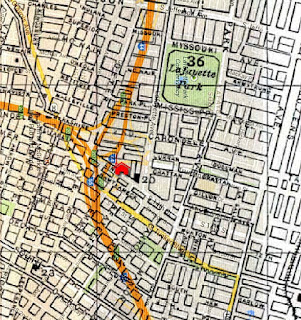
At the time of his death, Colonel Sigel lived at 1853 or 1929 Linn Avenue in south St. Louis, a location that today would be at the I-44/I-55 interchange, southeast of Lafayette Park. Many of the streets no longer exist, including this section of Linn Avenue, and several others now have different names.
The St. Louis Death Registry shows that Colonel Sigel is buried at “New Picker's Cemetery,” which was seized by the City of St. Louis and renamed Gatewood Gardens Cemetery. Unfortunately, the records from 1861 to 1891 are missing and all that remains is a handwritten transcription of the log, in which Colonel Sigel cannot be found. He is therefore most likely buried in an unmarked grave at the cemetery, lost to time.
Colonel Sigel has been mostly lost to time: obscured by the shadow of his brother Franz, left without descendants by his children and overtaken by the march of history. The record nevertheless shows him as a dedicated United States soldier and commander, and a public servant to the state of Missouri.
Works Cited
National Park Service. The Civil War Soldiers and Sailors Database: Battle Units. Accessed January 6, 2015.
“Burial of Col. Albert Sigel.” New York Times, March 21, 1884.
The Union Army: A History of Military Affairs in the Loyal States, 1861–65; Records of the Regiments in the Union Army; Cyclopedia of Battles; Memoirs of Commanders and Soldiers. Vol. V, Cyclopedia of Battles A–Helena. Madison, Wisconsin: Federal Publishing Company, 1908.
United States War Department. The War of the Rebellion: A Compilation of the Official Records of the Union and Confederate Armies. Washington, D.C.: Government Printing Office, 1901.
Wood, William D. Report of the Adjutant General. St. Louis: Headquarters, State of Missouri Adjutant General's Office, 1863.
Notes
- 1880 United States Census, St. Louis, St. Louis (Independent City), Missouri; roll 721; Family History Film 1254721; page 637C; Enumeration District 100.
- Missouri Secretary of State, “Missouri Digital Heritage,” Missouri Death Certificates, 1910–1963.
- United States War Department, The War of the Rebellion, serial 019, page 321, chapter XXV.
- William D. Wood, Report of the Adjutant General, 483.
- The War of the Rebellion, serial 086, page 707, chapter LIII.
- The War of the Rebellion, serial 083, page 375, chapter LIII.
- “Burial of Col. Albert Sigel,” New York Times, March 21, 1884.